




Tag Archives: fraud

NEWSLETTER: Exposed — Democrat motivations on the income tax and fraud at DCYF


Daycare fraud concerns should be a priority

Dear Friends and Neighbors,

Since news came to light months ago about the rampant daycare fraud in Minnesota, I have been concerned about the possibility of similar fraud here in Washington.

As the legislative session got underway, I shared these concerns publicly. Democrat leaders in Olympia dismissed them as unfounded; the Speaker of the House went so far as to say such concerns were an insult to legitimate daycare owners in Washington. I said that anyone operating legitimately should want fraud to be uncovered and addressed so their own businesses don’t suffer guilt by association. Moreover, any money we lose because of fraud means fewer dollars for people who need those services.

I was right to be concerned.

A recent audit uncovered $37 million in questionable payments from federal tax dollars to daycare providers in Washington.

An article in the Washington State Standard reported, “The $37 million the audit identified is made up of $27.2 million in federal Child Care and Development Fund grants and $9.9 million from the Temporary Assistance for Needy Families, or TANF, program.”

This means that $1 of every $5 (or 20% of the total amount) DCYF paid out was an overpayment.

LISTEN TO MY PODCAST ABOUT FRAUD AT DCYF

While some were overpaid, others overbilled the state. While this doesn’t necessarily prove fraud in the system, it does prove that the DCYF lacks proper documentation to back up its spending and/or isn’t complying with federal requirements.

DCYF has not referred the audit findings to the Office of Fraud and Accountability for review. According to the Washington State Standard, DCYF says the cases of questionable payments did not “rise to the level of suspected fraud or intentional deception.”

I disagree.

If the fault for overpayments lies with DCYF, that indicates gross incompetence and mismanagement. DCYF claims they don’t have enough staff to adequately review hundreds of thousands of payments. That should be remedied.

But, if some daycare providers are overbilling the state and can’t provide documentation to justify their numbers, that indicates fraud and should be further investigated for “intentional deception.”

Every dollar the state spends comes from hardworking taxpayers, and while agencies such as DCYF waste 20% of their payouts on overpayments, the Democrat majority continues to raise taxes and claim that they need more and more revenue.

Republicans often say that Washington doesn’t have a revenue problem — it has a spending problem. If Democrats took audit findings such as these more seriously, there would be room in existing revenue to fund the state’s priorities without demanding another dime from you.

I’ll continue to follow this situation closely and work toward greater accountability at DCYF and in other state agencies.

READ MY RECENT COLUMN ON THE DCYF AUDIT

If you have any questions or comments, email me or call my office at (360) 786-7638.

Sincerely,

John Braun


Emails show true motive for the income tax

For years, Republicans have asserted that Democrats would eventually pass a state income tax, knowing it is unconstitutional, with the intention of triggering legal challenges that would eventually force the Washington State Supreme Court to reconsider its 1933 decision that determined income is property.

We knew their hope was that the increasingly liberal Court would overturn more than 90 years of legal precedent and rule that income is not property, which would make a graduated income tax – like the one Democrats passed this past legislative session — legal in Washington.

This was recently confirmed in an article appearing in the Center Square, which quotes reports emails between the Senate majority leader and the Attorney General’s office, which were found through a public records request.

As you recall, Democrats passed that income tax after branding it a “Millionaires’ Tax” and claiming it only affects people who make more than $1 million a year. Democrats actually voted two years ago to ban an income tax at both the state and local level. When confronted with this, the Senate majority leader called the vote a “pie crust promise,” which he said was easily made and easily broken.

During the legislative session, Republicans worked hard to shine a spotlight on the details of that income tax proposal. These include:

  • Hurts small businesses
  • Contains a marriage penalty
  • Can be expanded easily – both in rate and in who it applies to
  • Will cause job providers and others to move out of state

It also contains a clause that prevents the public from overturning the tax through referendum. The Center Square article reveals that the initial draft of the bill did not include this clause — it was added at the suggestion of Solicitor General Noah Purcell.

Democrats held hearings on the income tax in both the House and Senate. Senate Republicans lead a grassroots effort calling on people to sign in to oppose the bill. More than 118,000 people signed in against it. The actual testimony heard in committee was 2 to 1 opposed.

After the hearings, when asked about the groundswell of opposition to the bill, Democrat leadership said, “We don’t pay attention to people who sign in, but not to testify” and “They’re not helping us make decisions.”

Republicans, however, fought hard to educate the public about the bill – to see the big picture about how the tax will affect Washington’s economy. We are already seeing companies such as Starbucks and wealthy individuals leaving Washington – taking with them jobs and the revenue source the tax depends on.

We will continue to fight against a state income tax next year, as we expect Democrats to attempt to broaden it.

“An income tax on anyone in Washington will become an income tax on everyone in Washington.”

– Rep. Drew Stokesbary
31st District


Survey says affordability is
still the top concern


The results are in for the short online survey I included in a previous e-newsletter and a recent mailer sent out to my constituents.

The biggest takeaway is that 88% of those who responded do NOT support a state income tax if it applies to them.

In fact, more than 90% think the Legislature should send major tax proposals, such as the new state income tax, to voters for approval. Less than 7% disagreed.

Approximately 92% of people in our district think state government should live within existing revenue and stop raising taxes for new programs.

Also, affordability is still the biggest challenge facing communities and families. Of those surveyed, less than 2% are not concerned about the rising cost of living in Washington. In contrast, 80% are “very concerned” or “extremely concerned.”

Other highlights:

  • 40% think preventing new taxes and tax increases should be the Legislature’s top priority in 2027
  • 22% think the top priority should be reducing government spending
  • More than 75% think Washington is currently headed in the right direction
  • 74.19% believe the Legislature should prioritize stronger laws to support law enforcement and reduce crime

When asked what they believe is the biggest factor driving up the cost of housing in Washington, answers showed:

  • Government regulation (34.43%)
  • Taxes and fees (22.95%)
  • Population growth (21.31%)
  • High interest rates (8.2%)
  • Other (13.11%)

When asked what the biggest challenge our communities face right now, the most frequent responses said the high cost of living, taxes, decaying infrastructure and increasing the number of police officers while also prosecuting more criminals.

When asked what the biggest challenge their families are facing, the most common answers were affordability (especially rent, energy, healthcare and childcare), property taxes, government overregulation, and the quality of education their children are getting.


Thank you for a successful town hall

Thank you to everyone who participated in the 20th Legislative District virtual town hall hosted online by Rep. Peter Abbarno, Rep. Ed Orcutt and me on April 13.

People asked many great questions. Not surprisingly, the new income tax and the cost of living in Washington were top concerns.


If you missed it, you can
listen to it now.

Stopping fraud in state housing grant program

Dear Friends and Neighbors,

There’s been plenty of news lately about the defrauding of government programs, specifically by some daycare owners in Minnesota. While that issue has received a lot of attention, it is not unique. Across the country, people commit fraud against all kinds of publicly funded programs, accessing benefits intended for people who are truly in need.

Not only is this morally wrong, it’s criminal.

Every taxpayer should be concerned about fraud — that’s your money being stolen or misused — and I’m sponsoring Senate Bill 6205 to address a specific category of fraud here in Washington.

Fortunately, SB 6205 is scheduled for a hearing in the Senate Housing Committee at 10:30 a.m. on Wednesday, Jan. 28. Before the hearing, you can:

  • Sign in online to support the bill,
  • Testify on the bill from home OR in person; or,
  • Submit written testimony to the committee.

Learn how to testify in committee.

Read my news release.

Listen to my radio release.


WHAT DOES SB 6205 DO?

SB 6205 addresses the bad combination of nepotism, fraud and lack of accountability in a publicly funded housing program designed to help people of color become homeowners. It’s called the Community Reinvestment Plan (CRP).

The bill would make it illegal for the officers of any of the nonprofits in charge of distributing CRP money, and their family members, to receive any of the housing grants or benefitting from the grants indirectly.

The bill would also require the Department of Commerce to evaluate how the grants are distributed and make the results available to the Legislature.


WHY DO WE NEED THIS REFORM?

According to information recently provided by a whistleblower, one of the nonprofits in charge of distributing money for the CRP gave hundreds of thousands of dollars to people with close family connections to the organization while others in need went without.

In one instance, an individual received $350,000 toward the purchase of a $425,000 home. It turned out that her mother controls the purse strings for one of the nonprofits in charge of distributing the grants. Two other people with ties to the same organization received $50,000 and $100,000 respectively. Part of the $50,000 grant was reportedly used by the recipient to pay off her credit card debt.

Next week, I will share committee testimony on SB 6205. If you have questions or concerns, you can email me at john.braun@leg.wa.gov.

Sincerely,

Senator John Braun


WATCH: Fraud, fentanyl and the income tax

Watch my weekly legislative update for week two of the 2026 Legislative Session.
I cover fraud, fentanyl and the income tax.


Protecting children from exposure to fentanyl

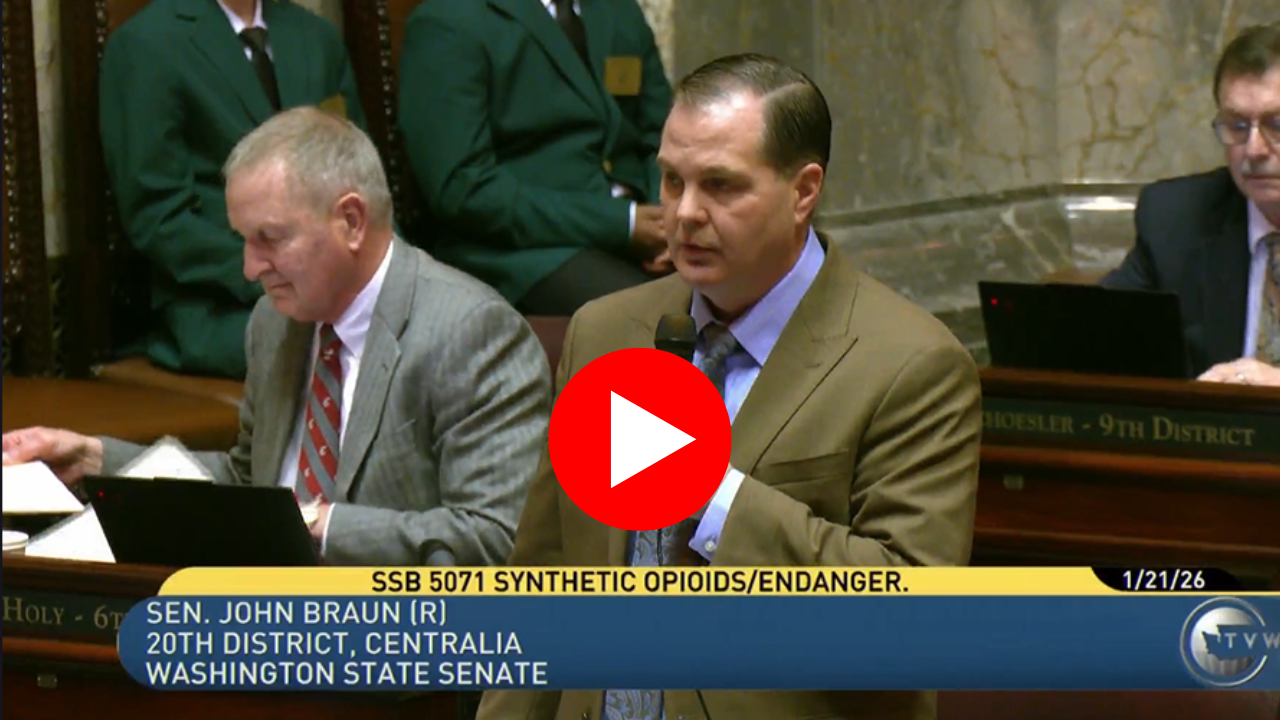
WATCH MY FLOOR SPEECH

My bill to add fentanyl to the child endangerment statute passed the Senate with strong bipartisan support for the fourth time. It is headed back to the House, where I hope the majority will grant it a hearing in committee and a vote on the House floor.

Read my news release about SB 5071.


“Three strikes” and you’re out…on the street


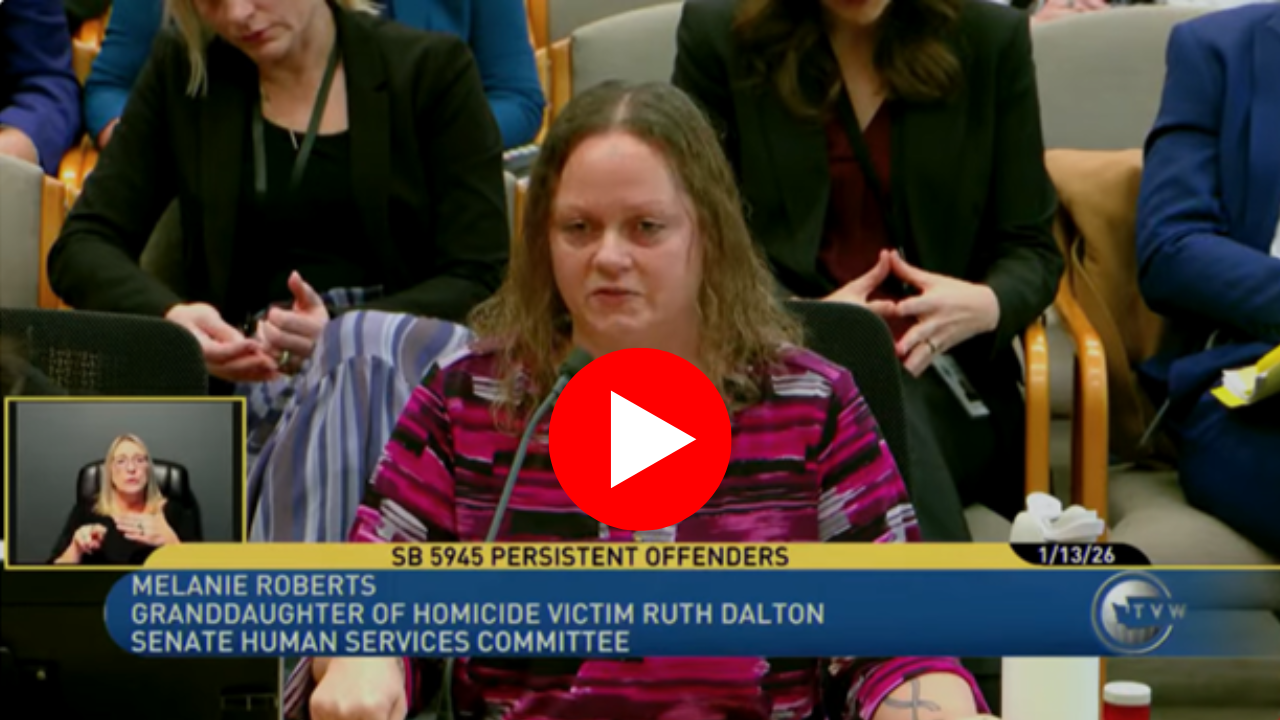
Watch the testimony of Melanie Roberts, whose 80-year-old grandmother was murdered in Seattle in 2024 by a perpetrator who should have already had three strikes.


The latest attempt by the Legislature’s Democratic majority to weaken Washington’s “Three Strikes Law” received a committee hearing recently. It included a sad display of disrespect by the committee chair toward one of the testifiers — Melanie Roberts, whose 80-year-old grandmother was murdered in Seattle by someone who could escape a life-without-parole sentence if Senate Bill 5945 passes. Watch Melanie’s testimony.

“I want you to think if you know anybody who has been impacted by a violent act — drunk driver, assault, rape, murder. Would it make it ok if the drunk driver, rapist, robber or murderer was under 18? Would the victim be any less violated, traumatized or dead? No.

“So if the outcome is the same for the victims, why is it different for the perpetrators?”

-Melanie Roberts

Since 1994, Washington’s Persistent Offender Accountability Act, better known as the “Three Strikes Law,” has required a sentence of “life imprisonment without parole” for a third conviction of a serious violent felony. It was intended to keep people safe from repeat offenders who commit crimes such as murder, rape, robbery and assault with a deadly weapon.

SB 5945 would eliminate “strikes,” or serious crime convictions, if they were committed by offenders when they were juveniles. This would roll back some current inmates to two strikes, instead of three, which would result in their life sentences being reduced.

The individual who killed Melanie’s grandmother in August 2024 has already been convicted of three violent crimes and should be serving life in prison, but what would have been his third strike was negotiated down in a plea deal. If SB 5945 passes, his latest conviction — which should be strike four — still won’t count as strike three. Why? Because he committed his first strike when he was under 18.

THE ARGUMENT

Supporters of SB 5945 argue that those under 18 lack the brain development to be held fully accountable for juvenile offenses — even violent ones such as rape and murder. Therefore, juvenile offenses shouldn’t factor into their sentencing if they commit more violent crimes in the future.

I strongly disagree. This policy prioritizes criminals over victims, plain and simple. Teenagers are old enough to know that raping a child, murdering their parents or beating an old woman to death is wrong. Because of its violent nature, that juvenile conviction should remain a strike toward life in prison. SB 5945 is an affront to victims and the victims’ surviving families and friends.

We’ve heard Democrats make this same tired argument before. The irony is that they seem to forget about those same underdeveloped brains when the discussion shifts to whether children can change their gender in kindergarten or get an abortion at any age — without parental consent.

This bill would affect the sentences of about 24 inmates, at present. That doesn’t take into account the effects it will have on those left permanently traumatized and victimized by these offenders. The bill would also prevent some of those who commit future violent crimes from being permanently removed from society.

WHAT NOW?

Majority Democrats voted SB 5945 out of committee on Wednesday. Every Republican on the committee voted “do not pass.” It now is set for a public hearing next Thursday, Jan. 29, before the Senate Ways and Means Committee. That’s when I will get to question the supporters directly.

You can help stop SB 5945 by contacting Senate Democrats to demand they put the bill down.

If Democrats ultimately pass it in the Senate, you will need to contact legislators in the House of Representatives and demand they do what the Senate would not.

If the House gives it a hearing, you will be able to sign in online to oppose the bill and register to testify against it. Make your voice heard.

I will update you on the movement of this bill so you can help stop this terrible legislation from becoming law.


Braun bill aims to protect housing grant program from fraud

OLYMPIA…Concerned by whistleblower reports of fraud and nepotism in a state housing-assistance program, Senate Republican Leader John Braun has introduced legislation to help ensure taxpayer dollars allocated to the program are distributed fairly and as state law intends.

Senate Bill 6205 aims to prevent unfair insider access to housing grants from the Community Reinvestment Plan (CRP), which is intended to help people of color become homeowners. The Centralia lawmaker said his legislation also requires the state Department of Commerce to evaluate how the grants are distributed and report to the Legislature.

Under the 2022 law creating the CRP, funding allocated for housing grants is funneled through nonprofit organizations, which are expected to distribute it equitably. However, recent news reports based on a whistleblower’s records showed that a woman who received $350,000 toward the purchase of a $425,000 home in Tacoma happens to be the daughter of the person overseeing CRP housing grants for one of these nonprofits.

Others associated with the same nonprofit also received large grants, with some of that money reportedly used to pay off a recipient’s credit-card debt.

“Defrauding publicly funded programs is stealing from taxpayers,” said Braun, who serves southwest Washington’s 20th Legislative District. “If those entrusted to allocate taxpayer dollars violate that trust by awarding housing grants inappropriately, they should be held accountable. Bad actors shouldn’t be able to exploit taxpayers for their own gain.

“The intent of the CRP is to assist people with down payments and closing costs to get them into a home. It’s certainly not about helping friends and family of those holding the purse strings to cover most of a home’s total cost while leaving other applicants with no help at all. This bill would reform the program so it can benefit more of the people it was created to help.”

SB 6205 has been referred to the Senate Housing Committee and awaits a hearing.

News stories regarding misuse of CRP funding:

##