





Tag Archives: fentanyl

NEWSLETTER: Income tax to be heard in the House Feb. 24 — sign in CON again

Watch my weekly legislative update video.


Dear Friends and Neighbors,

You might be tired of hearing about the income bill, and I am tired of talking about it. But this bill is so bad that we can’t stop talking about it until we stop the bill itself.

WATCH MY WEEKLY UPDATE

Senate Democrats passed the income tax (Senate Bill 6346) when it came to the Senate floor last week. Three of them joined us in voting “no.” Now the bill is being considered in the House of Representatives and the House Fiscal Committee has scheduled it for a hearing at 8 a.m. on Feb. 24.

You have until 6 a.m. that day to sign in CON on the bill. More than 61,000 people signed in CON when it was heard in the Senate. This made it the most unpopular bill in state history. We need you to do that again.

Proponents of the tax are in denial about how many people took the time to oppose the bill, saying they were bots. The Legislature’s system has safeguards against bots. Those claims are ridiculous and insulting to you, the people.

When we debated the bill in the Senate, Republicans offered several important amendments — all of which were defeated by Democrats. These amendments would have:

  • Ensured that the tax ONLY ever applies to millionaires.
  • Removed the clause in the bill that prevents the people from overturning the income tax through referendum.
  • Nullified the income tax unless voters approve an amendment to the Washington State Constitution to legalize an income tax.
  • Exempted diapers from sales tax.

You may have heard claims that stopping the income tax jeopardizes funding for education and healthcare. The truth is that not one dime of the $3.5 billion this bill is expected to raise every year is earmarked for education or healthcare.

Some Democrats have said that more than 40% of the current operating budget is spent on education — as if that means that the same will be true for any money this tax adds to the general fund. This is misleading. No such requirement exists for new revenue. The majority will be able to spend it however they want.

Tell them NO again. Sign in CON to oppose SB 6346 before it’s hearing on Feb. 24. You can also submit written testimony or sign up to testify during the hearing.


Bad Senate bills stopped in their tracks
Although a bill that hasn’t moved can be resurrected at any point during a legislative session, it doesn’t happen often. The following is a list of six bad bills that are considered “dead,” for all intents and purposes, because they were not passed by the Senate before the cutoff we reached Feb. 17.

I hope to have more to add to this list when this session ends in March, but sometimes we need to celebrate our wins as they come.

  • SB 5312 (Sponsor: Sen. Wellman): Would have shortened the length of time a sex offender convicted during a “net nanny” online sting must remain on the sex offender registry.
  • SB 5382 and SB 5973 (Sponsor: Valdez): These bills have been referred to as the Initiative Killer and the Initiative Killer 2.0. Both bills would have made it harder and more expensive for citizens to collect signatures for and submit initiatives/referenda to directly enact or overturn state laws. They would have undermined direct democracy and made it easier for legislators to pass taxes and other bills without fear that the people would intervene.
  • SB 5926 (Sponsor: Wellman): This bill would have exempted state-subsidized daycares from certain public records requirements, making it more difficult for the public to obtain information about daycares and their owners. Although it was filed before news of daycare fraud in Minnesota became public, the bill would have undermined transparency if something similar happened in Washington.
  • SB 5942 (Sponsor: Wilson, C.): A surge in lawsuits alleging various forms of misconduct has forced Washington state government to make more and larger payouts on claims for child fatalities and near-fatalities. This has become the fastest-growing part of the state operating budget as well as a statewide tragedy. SB 5942 would have made things far worse by eliminating the oversight responsibilities of the Department of Children, Youth and Families (DCYF) Oversight Board. Ironically, the bill also would have changed the name to the DCYF Accountability Board.
  • SB 5945 (Sponsor: Hasegawa): This would have changed the “Three Strikes Law” so that rapes, murders, robberies and assaults with a deadly weapon would not count if they were committed when the offender was a juvenile. It would have allowed the man who murdered the 80-year-old dog walker in Seattle to avoid life in prison, despite having a long history of violence, because his conviction would have only counted as strike two. Twenty-four current prisoners serving life in prison would lose a strike and could petition for resentencing.

Often, we can only shake our heads at some of the bills introduced in Olympia. As Republicans continue to fight against additional bad legislation, I’m glad to share these early victories with you.

At the end of the legislative session, I will share a longer status list of bills — good and bad.


My Podcast: Fentanyl, Families, and the Fight for Child Safety

LISTEN

This week on my podcast, Fostering Change Washington’s Jamie Williams and I discuss stalled child protection bills and the urgent need to update Washington’s child endangerment laws. We explore the fentanyl crisis, legislative roadblocks, and how citizens can push for accountability to protect vulnerable children from drug-exposed environments.


Lives Lost, Billions Paid: The Costly Toll of State Negligence

Mismanagement by state agencies has played a role in the deaths and near-deaths of many Washington children and put other residents at risk.

Opioid overdose is a big culprit, which is why I again sponsored SB 5071, which would have added fentanyl to the list of drugs in the Child Endangerment Act. For the fourth time, the bill has failed to move through the House, despite strong bipartisan support in the Senate.

It’s a mystery why House Democrats will not pass such a simple bill to protect children from accidental overdose.

If you need convincing about the importance of this legislation, read “Lives Lost, Billions Paid: The Costly Toll of State Negligence” on the Senate Republican website.


READ MORE


Stopping fraud in state housing grant program

Dear Friends and Neighbors,

There’s been plenty of news lately about the defrauding of government programs, specifically by some daycare owners in Minnesota. While that issue has received a lot of attention, it is not unique. Across the country, people commit fraud against all kinds of publicly funded programs, accessing benefits intended for people who are truly in need.

Not only is this morally wrong, it’s criminal.

Every taxpayer should be concerned about fraud — that’s your money being stolen or misused — and I’m sponsoring Senate Bill 6205 to address a specific category of fraud here in Washington.

Fortunately, SB 6205 is scheduled for a hearing in the Senate Housing Committee at 10:30 a.m. on Wednesday, Jan. 28. Before the hearing, you can:

  • Sign in online to support the bill,
  • Testify on the bill from home OR in person; or,
  • Submit written testimony to the committee.

Learn how to testify in committee.

Read my news release.

Listen to my radio release.


WHAT DOES SB 6205 DO?

SB 6205 addresses the bad combination of nepotism, fraud and lack of accountability in a publicly funded housing program designed to help people of color become homeowners. It’s called the Community Reinvestment Plan (CRP).

The bill would make it illegal for the officers of any of the nonprofits in charge of distributing CRP money, and their family members, to receive any of the housing grants or benefitting from the grants indirectly.

The bill would also require the Department of Commerce to evaluate how the grants are distributed and make the results available to the Legislature.


WHY DO WE NEED THIS REFORM?

According to information recently provided by a whistleblower, one of the nonprofits in charge of distributing money for the CRP gave hundreds of thousands of dollars to people with close family connections to the organization while others in need went without.

In one instance, an individual received $350,000 toward the purchase of a $425,000 home. It turned out that her mother controls the purse strings for one of the nonprofits in charge of distributing the grants. Two other people with ties to the same organization received $50,000 and $100,000 respectively. Part of the $50,000 grant was reportedly used by the recipient to pay off her credit card debt.

Next week, I will share committee testimony on SB 6205. If you have questions or concerns, you can email me at john.braun@leg.wa.gov.

Sincerely,

Senator John Braun


WATCH: Fraud, fentanyl and the income tax

Watch my weekly legislative update for week two of the 2026 Legislative Session.
I cover fraud, fentanyl and the income tax.


Protecting children from exposure to fentanyl

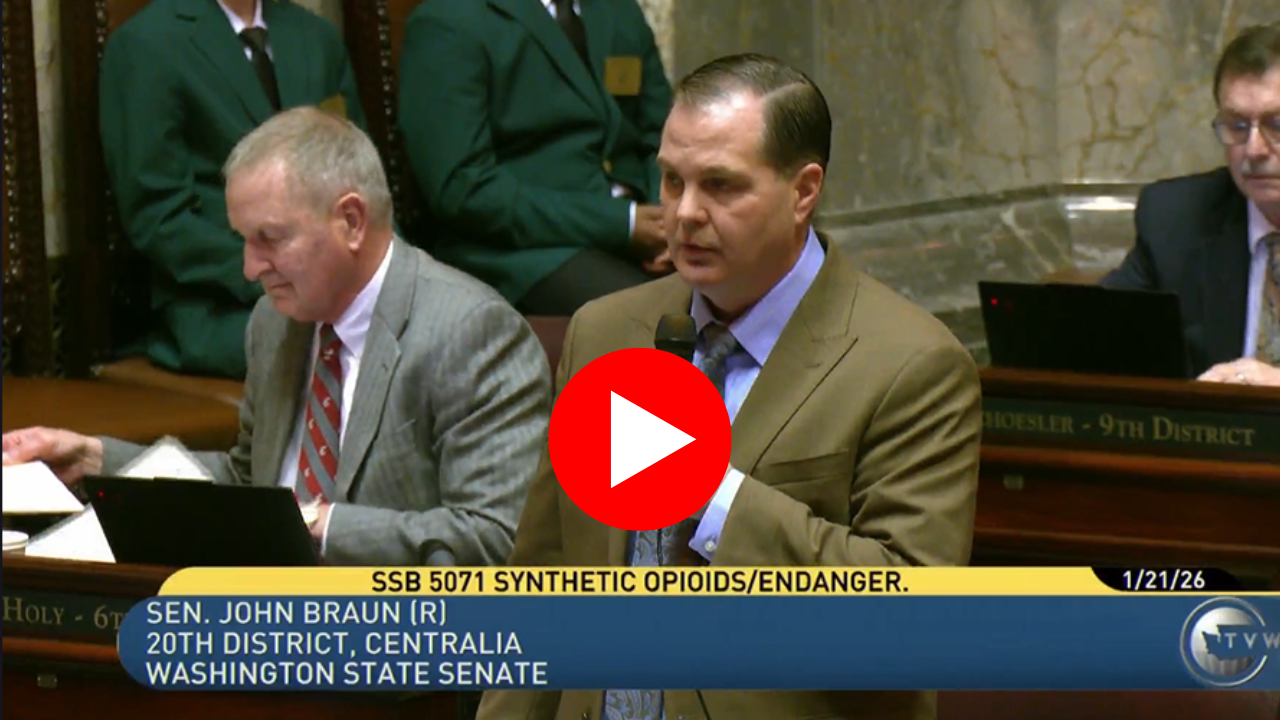
WATCH MY FLOOR SPEECH

My bill to add fentanyl to the child endangerment statute passed the Senate with strong bipartisan support for the fourth time. It is headed back to the House, where I hope the majority will grant it a hearing in committee and a vote on the House floor.

Read my news release about SB 5071.


“Three strikes” and you’re out…on the street


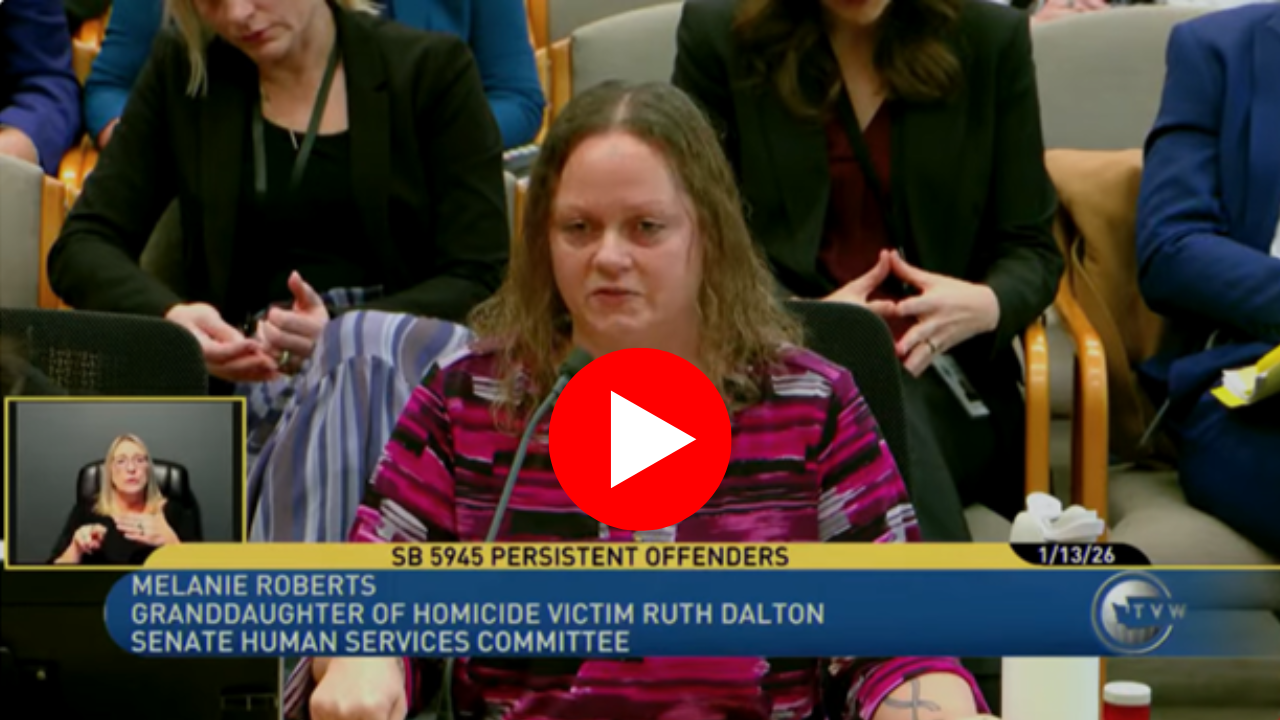
Watch the testimony of Melanie Roberts, whose 80-year-old grandmother was murdered in Seattle in 2024 by a perpetrator who should have already had three strikes.


The latest attempt by the Legislature’s Democratic majority to weaken Washington’s “Three Strikes Law” received a committee hearing recently. It included a sad display of disrespect by the committee chair toward one of the testifiers — Melanie Roberts, whose 80-year-old grandmother was murdered in Seattle by someone who could escape a life-without-parole sentence if Senate Bill 5945 passes. Watch Melanie’s testimony.

“I want you to think if you know anybody who has been impacted by a violent act — drunk driver, assault, rape, murder. Would it make it ok if the drunk driver, rapist, robber or murderer was under 18? Would the victim be any less violated, traumatized or dead? No.

“So if the outcome is the same for the victims, why is it different for the perpetrators?”

-Melanie Roberts

Since 1994, Washington’s Persistent Offender Accountability Act, better known as the “Three Strikes Law,” has required a sentence of “life imprisonment without parole” for a third conviction of a serious violent felony. It was intended to keep people safe from repeat offenders who commit crimes such as murder, rape, robbery and assault with a deadly weapon.

SB 5945 would eliminate “strikes,” or serious crime convictions, if they were committed by offenders when they were juveniles. This would roll back some current inmates to two strikes, instead of three, which would result in their life sentences being reduced.

The individual who killed Melanie’s grandmother in August 2024 has already been convicted of three violent crimes and should be serving life in prison, but what would have been his third strike was negotiated down in a plea deal. If SB 5945 passes, his latest conviction — which should be strike four — still won’t count as strike three. Why? Because he committed his first strike when he was under 18.

THE ARGUMENT

Supporters of SB 5945 argue that those under 18 lack the brain development to be held fully accountable for juvenile offenses — even violent ones such as rape and murder. Therefore, juvenile offenses shouldn’t factor into their sentencing if they commit more violent crimes in the future.

I strongly disagree. This policy prioritizes criminals over victims, plain and simple. Teenagers are old enough to know that raping a child, murdering their parents or beating an old woman to death is wrong. Because of its violent nature, that juvenile conviction should remain a strike toward life in prison. SB 5945 is an affront to victims and the victims’ surviving families and friends.

We’ve heard Democrats make this same tired argument before. The irony is that they seem to forget about those same underdeveloped brains when the discussion shifts to whether children can change their gender in kindergarten or get an abortion at any age — without parental consent.

This bill would affect the sentences of about 24 inmates, at present. That doesn’t take into account the effects it will have on those left permanently traumatized and victimized by these offenders. The bill would also prevent some of those who commit future violent crimes from being permanently removed from society.

WHAT NOW?

Majority Democrats voted SB 5945 out of committee on Wednesday. Every Republican on the committee voted “do not pass.” It now is set for a public hearing next Thursday, Jan. 29, before the Senate Ways and Means Committee. That’s when I will get to question the supporters directly.

You can help stop SB 5945 by contacting Senate Democrats to demand they put the bill down.

If Democrats ultimately pass it in the Senate, you will need to contact legislators in the House of Representatives and demand they do what the Senate would not.

If the House gives it a hearing, you will be able to sign in online to oppose the bill and register to testify against it. Make your voice heard.

I will update you on the movement of this bill so you can help stop this terrible legislation from becoming law.


STATEMENT: Republican leader cautious about drug-law ‘special’ session

CENTRALIA… State lawmakers have been called into a special session to continue work toward a new state law on the possession of controlled substances, after failing to come to an agreement before the regular legislative session ended April 23.

Senate Republican Leader John Braun offered this comment following Gov. Jay Inslee’s proclamation that the Legislature will reconvene May 16.

“The governor had indicated he would not call a special session until legislative leaders reached an agreement that is worth bringing in front of each chamber. To be clear, we’re not to that point yet, although there have been productive bipartisan discussions over the past week. In that sense his announcement today was unexpected.

“Republicans worked in good faith throughout the regular session toward a new law that will give drug offenders more incentive to enter and complete treatment. We remain committed to that. While I am hopeful for a better outcome this next time around, there is also reason to be cautious. The House Democrats will need to demonstrate a combination of bipartisanship and leadership that was missing during the 105 days of the regular session – especially at the end, when they failed to pass a proposal that was still far from reasonable, and Democrats from all corners falsely claimed that failure was somehow the fault of Republicans, even though we are in the minority.

“All along, Republicans have insisted on a new drug-possession policy that truly works for the stakeholders – law enforcement, the criminal-justice system, and local governments. They need more leverage to save lives, lift people out of the despair that goes with being addicted to drugs like fentanyl, and also reclaim our streets and sidewalks. That’s still the right path for the upcoming special session. We must do better.”