








Dear Friends and Neighbors,
There’s been plenty of news lately about the defrauding of government programs, specifically by some daycare owners in Minnesota. While that issue has received a lot of attention, it is not unique. Across the country, people commit fraud against all kinds of publicly funded programs, accessing benefits intended for people who are truly in need.
Not only is this morally wrong, it’s criminal.
Every taxpayer should be concerned about fraud — that’s your money being stolen or misused — and I’m sponsoring Senate Bill 6205 to address a specific category of fraud here in Washington.
Fortunately, SB 6205 is scheduled for a hearing in the Senate Housing Committee at 10:30 a.m. on Wednesday, Jan. 28. Before the hearing, you can:
- Sign in online to support the bill,
- Testify on the bill from home OR in person; or,
- Submit written testimony to the committee.
Learn how to testify in committee.
WHAT DOES SB 6205 DO?
SB 6205 addresses the bad combination of nepotism, fraud and lack of accountability in a publicly funded housing program designed to help people of color become homeowners. It’s called the Community Reinvestment Plan (CRP).
The bill would make it illegal for the officers of any of the nonprofits in charge of distributing CRP money, and their family members, to receive any of the housing grants or benefitting from the grants indirectly.
The bill would also require the Department of Commerce to evaluate how the grants are distributed and make the results available to the Legislature.
WHY DO WE NEED THIS REFORM?
According to information recently provided by a whistleblower, one of the nonprofits in charge of distributing money for the CRP gave hundreds of thousands of dollars to people with close family connections to the organization while others in need went without.
In one instance, an individual received $350,000 toward the purchase of a $425,000 home. It turned out that her mother controls the purse strings for one of the nonprofits in charge of distributing the grants. Two other people with ties to the same organization received $50,000 and $100,000 respectively. Part of the $50,000 grant was reportedly used by the recipient to pay off her credit card debt.
Next week, I will share committee testimony on SB 6205. If you have questions or concerns, you can email me at john.braun@leg.wa.gov.
Sincerely,
Senator John Braun
WATCH: Fraud, fentanyl and the income tax

Watch my weekly legislative update for week two of the 2026 Legislative Session.
I cover fraud, fentanyl and the income tax.
Protecting children from exposure to fentanyl
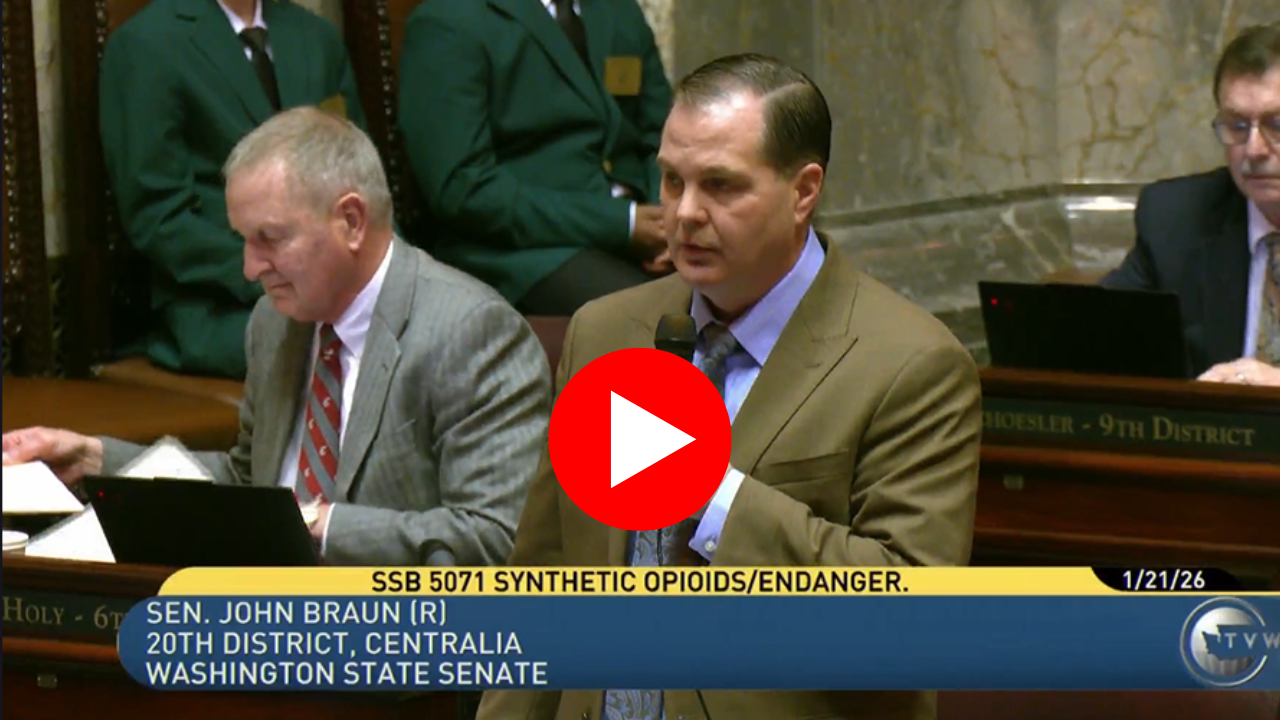
My bill to add fentanyl to the child endangerment statute passed the Senate with strong bipartisan support for the fourth time. It is headed back to the House, where I hope the majority will grant it a hearing in committee and a vote on the House floor.
Read my news release about SB 5071.
“Three strikes” and you’re out…on the street
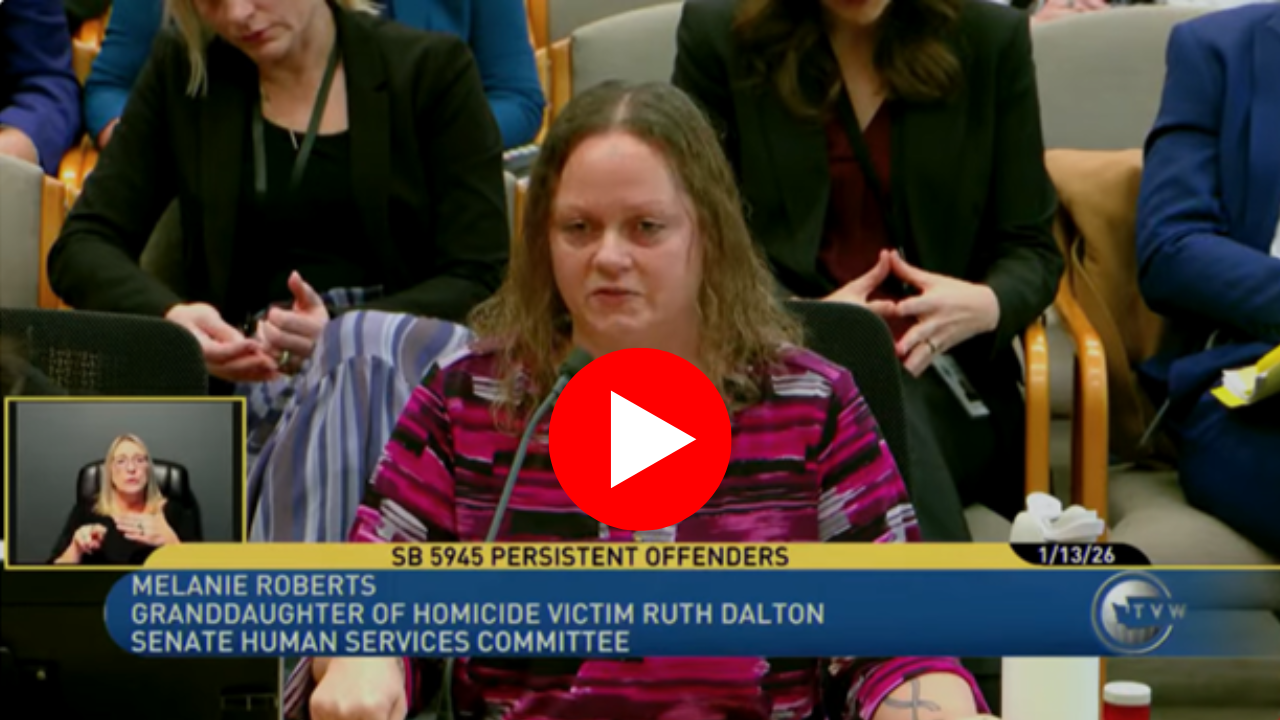
Watch the testimony of Melanie Roberts, whose 80-year-old grandmother was murdered in Seattle in 2024 by a perpetrator who should have already had three strikes.
The latest attempt by the Legislature’s Democratic majority to weaken Washington’s “Three Strikes Law” received a committee hearing recently. It included a sad display of disrespect by the committee chair toward one of the testifiers — Melanie Roberts, whose 80-year-old grandmother was murdered in Seattle by someone who could escape a life-without-parole sentence if Senate Bill 5945 passes. Watch Melanie’s testimony.
“I want you to think if you know anybody who has been impacted by a violent act — drunk driver, assault, rape, murder. Would it make it ok if the drunk driver, rapist, robber or murderer was under 18? Would the victim be any less violated, traumatized or dead? No.
“So if the outcome is the same for the victims, why is it different for the perpetrators?”
-Melanie Roberts
Since 1994, Washington’s Persistent Offender Accountability Act, better known as the “Three Strikes Law,” has required a sentence of “life imprisonment without parole” for a third conviction of a serious violent felony. It was intended to keep people safe from repeat offenders who commit crimes such as murder, rape, robbery and assault with a deadly weapon.
SB 5945 would eliminate “strikes,” or serious crime convictions, if they were committed by offenders when they were juveniles. This would roll back some current inmates to two strikes, instead of three, which would result in their life sentences being reduced.
The individual who killed Melanie’s grandmother in August 2024 has already been convicted of three violent crimes and should be serving life in prison, but what would have been his third strike was negotiated down in a plea deal. If SB 5945 passes, his latest conviction — which should be strike four — still won’t count as strike three. Why? Because he committed his first strike when he was under 18.
THE ARGUMENT
Supporters of SB 5945 argue that those under 18 lack the brain development to be held fully accountable for juvenile offenses — even violent ones such as rape and murder. Therefore, juvenile offenses shouldn’t factor into their sentencing if they commit more violent crimes in the future.
I strongly disagree. This policy prioritizes criminals over victims, plain and simple. Teenagers are old enough to know that raping a child, murdering their parents or beating an old woman to death is wrong. Because of its violent nature, that juvenile conviction should remain a strike toward life in prison. SB 5945 is an affront to victims and the victims’ surviving families and friends.
We’ve heard Democrats make this same tired argument before. The irony is that they seem to forget about those same underdeveloped brains when the discussion shifts to whether children can change their gender in kindergarten or get an abortion at any age — without parental consent.
This bill would affect the sentences of about 24 inmates, at present. That doesn’t take into account the effects it will have on those left permanently traumatized and victimized by these offenders. The bill would also prevent some of those who commit future violent crimes from being permanently removed from society.
WHAT NOW?
Majority Democrats voted SB 5945 out of committee on Wednesday. Every Republican on the committee voted “do not pass.” It now is set for a public hearing next Thursday, Jan. 29, before the Senate Ways and Means Committee. That’s when I will get to question the supporters directly.
You can help stop SB 5945 by contacting Senate Democrats to demand they put the bill down.
If Democrats ultimately pass it in the Senate, you will need to contact legislators in the House of Representatives and demand they do what the Senate would not.
If the House gives it a hearing, you will be able to sign in online to oppose the bill and register to testify against it. Make your voice heard.
I will update you on the movement of this bill so you can help stop this terrible legislation from becoming law.