Tag Archives: Braun

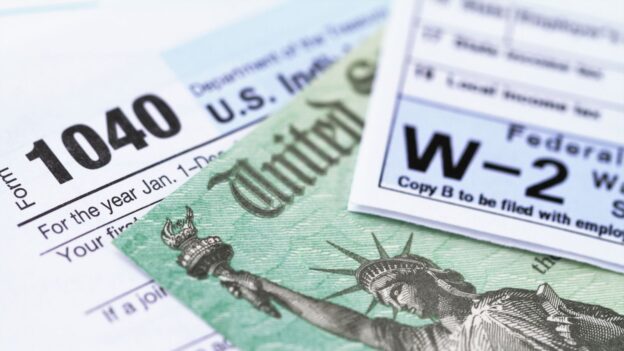
Are you broke yet? Democrats ready to pass even more taxes in 2026

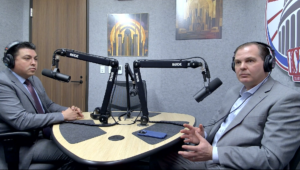
LISTEN: Jobs Tax. Income Tax. Innovation Tax. Sen. John Braun Says: Enough to Democrat Tax Hikes

Dear Friends and Neighbors,

Affordability remains the number one concern for families across Washington, yet the policies championed by Democrats in Olympia continue to push our state further out of step with the rest of the country. Instead of easing pressures, their decisions are making Washington one of the least affordable places to live, work, and run a business.

Gas prices are falling nationwide, but Washington still ranks among the top three most expensive states in the country. Our restaurants face the highest operating costs in America while earning the lowest profit margins. Schools, nonprofits, and small businesses are still suffering from last year’s expansion of the sales tax.

As we approach the 2026 legislative session, people have every reason to be concerned. We are currently facing a $4 billion budget shortfall, but so far, we are hearing about proposals in the neighborhood of $11 billion in new or higher taxes.

Democratic leaders have already announced plans for a new tax on jobs—one that threatens our economy—and they have openly stated their intent to pass a state income tax this year.

When they tell you they plan to do this, believe them.


The reality about a state income tax

Washington’s constitution prohibits a graduated income tax. Any tax that applies only to individuals earning above a certain amount—while exempting everyone else—is unconstitutional. Despite this, Democrats appear determined to push one through anyway and send it to the state Supreme Court, hoping the court will reclassify it as an “excise tax.”

If that happens, the door opens for the very tax Washington voters have rejected 11 times at the ballot box.

Some voters mistakenly believe that adopting an income tax would mean eliminating our sales tax. That is not on the table. There is no proposal—none—to model our system after Oregon’s, which has an income tax but no sales tax.

Meanwhile, several of our largest employers have already stated publicly that they will leave Washington if an income tax is enacted. For decades, our Democratic governors touted the lack of an income tax as a key incentive for companies to locate here. Now, the majority party is prepared to give those same employers every reason to leave.

We have a fight ahead

Republicans will fight to protect you, your paycheck, and your job from any attempt to impose an income tax in Washington. But we cannot do it alone.

You can make a difference by contacting Democratic legislators and telling them to reject this tax. You can testify when the bill receives a hearing. And you can encourage your friends, neighbors, and family members to get involved as well.

I will keep you updated as this and other harmful proposals move through the Legislature. Your participation matters. Your voice matters.

Together, we can make sure our voices are heard.

Sincerely,

Senator John Braun


Can Washington afford it?
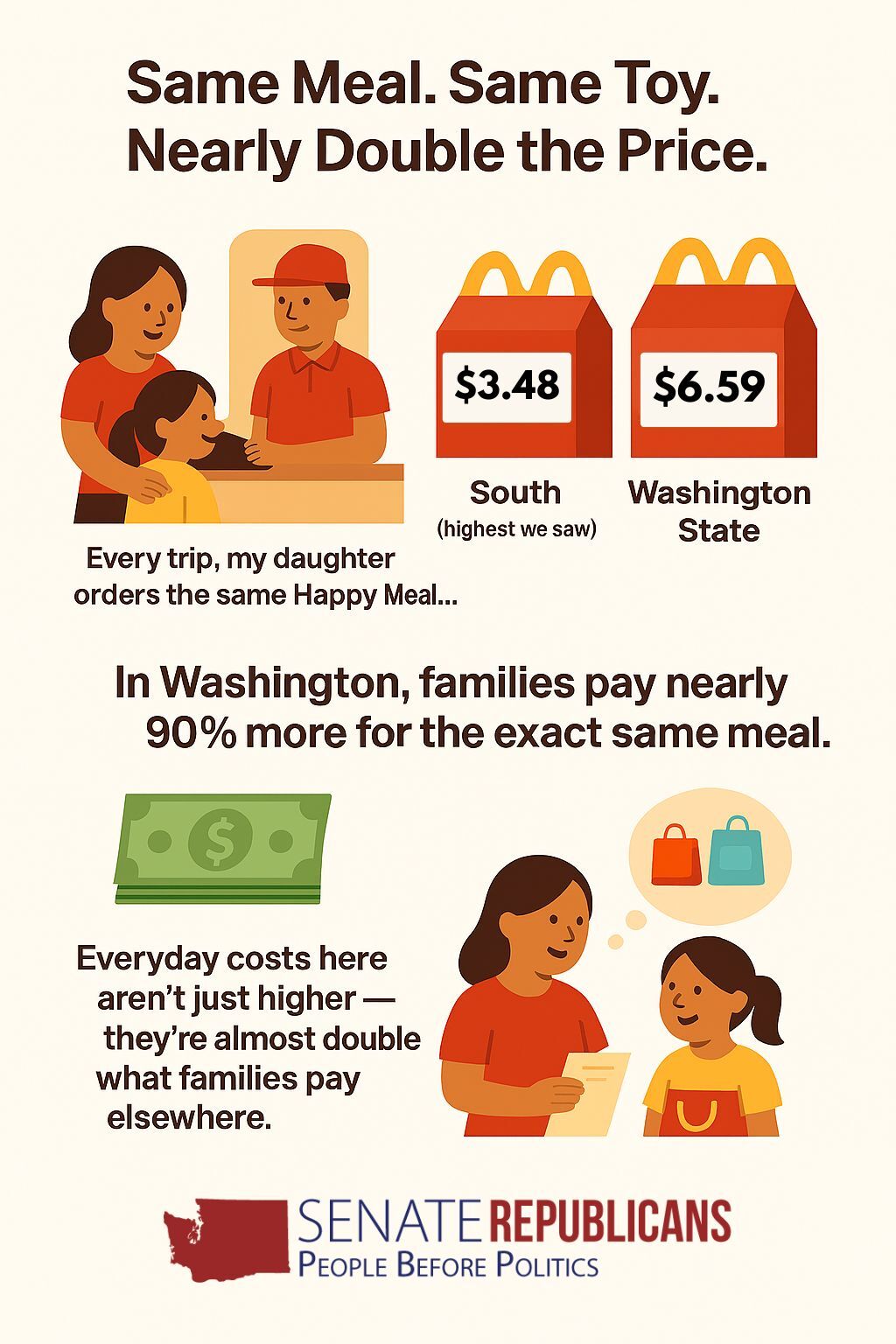
 

Before passing another law, we should ask one question: Can Washington afford it – not just in dollars, but
in safety, trust and opportunity?

Families across Washington are struggling to pay bills, find affordable housing, and feel safe in their
communities. Polls show “affordability” is the people’s top priority. Every decision in Olympia has a cost,
and it’s time we make affordability the test for every policy – financial, moral and generational.

As the minority, our job is to hold the majority accountable for the cost of their leadership and to offer
common-sense solutions Washington CAN afford.
This session we will connect every issue – from taxes to education to public safety – back to this simple,
people-centered truth:

Washington can’t afford policies that make life harder for the families we represent.


Myth vs fact:

MYTH: So much was cut from the budget last year that there isn’t anything left to cut.

FACT: The budget actually GREW by 8.2% last year. Democrats didn’t make cuts – they changed their funding priorities and programs such as one caring for drug-addicted babies were defunded.

MYTH: Last year’s deficit was $16 billion to $20 billion.

FACT: According to NONPARTISAN staff, the true deficit was $7.3 billion. Democrats made a policy choice to fund $4 billion in pay raises for state employees. They did NOT need to pass the largest tax increase in state history.

MYTH: We need more “revenue,” including an income tax.

FACT: The Democratic majority doesn’t have a revenue problem. It has a spending problem. Democrats need to reevaluate their priorities. Also, a graduated income tax, which taxes people at different rates based on their income, is unconstitutional in Washington and voters have rejected a state income tax 11 times. This hasn’t deterred Democrats from pushing for one and lobbying the state Supreme Court to consider it an excise tax instead.

By the numbers:

  • The fastest growing part of the budget is lawsuit settlements worth billions of taxpayer dollars paid to victims and their families for Democratic mismanagement of state agencies and their policies that result in the injury and death of the most vulnerable.
  • Washington remains dead last nationwide for the number of law enforcement officers per capita, despite the hiring of more than 300 new officers.
  • Washington is one of the three most expensive states for gas prices due to $0.52/gal in Democratic carbon taxes
  • The average household income in Washington is roughly half what is required to qualify for the median-priced home.
  • Washington’s restaurants have to charge the highest prices in the nation, but have the lowest profit margins in the nation (1.5% compared to the 4% national average).
  • Washington is rated 35th nationwide for business climate, down from 15th in 2022. The drop is due to the income tax on capital gains.
  • Washington ranks as the 7th least affordable state for infant care, with care for one infant costing 17.8% of a family’s yearly income.
  • Democratic policies will force an 18.6% electric rate hike over the next two years for many Western Washington consumers.
  • Washington could see blackouts across the state due to Democrats’ policies that will remove 1292 megawatts of electricity from the grid in 2026.


Keep Washington Livable

  • Reject policies that make life more expensive
  • Advance solutions that reduce costs and reward hard work and innovation
  • Protect jobs and keep job providers in Washington

Washington can’t afford higher taxes and fewer economic opportunities.


Keep Washington Safe

  • Prioritize victims over offenders
  • Expand and strengthen law enforcement
  • Protect kids from overdoses, abuse and exploitation

Washington can’t afford policies that put our communities in danger.


Keep Washington’s Promise

  • Improve public school academic attendance and performance
  • Support stronger, healthier families
  • Reinvest in foster care and childcare programs

Washington can’t afford to neglect its responsibility to our kids and to their future prosperity.


Local flooding and a state of emergency
The 20th Legislative District has been impacted by heavy rains this week, resulting in localized flooding and landslides. Randall is completely cut off and Highway 12 remains closed, officials do not know when roads will reopen.

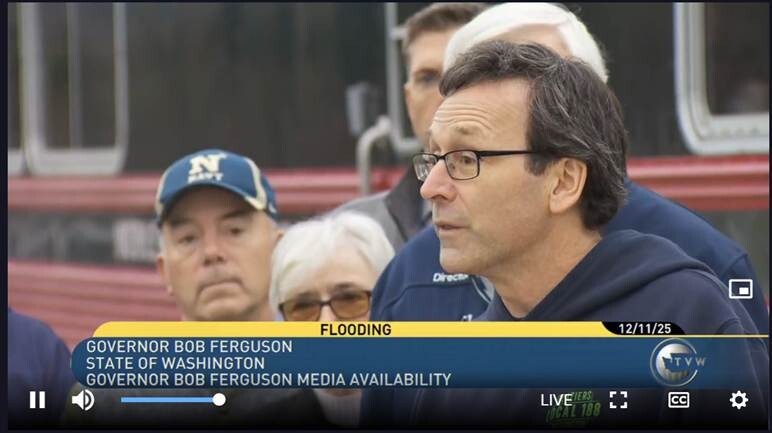
The governor has declared a state of emergency, which includes the activation of 300 National Guardsmen to assist with response (pending approval from the federal government.)

Today, at noon, he held a news conference to update everyone on the status of the response. Watch the press conference.

According to the governor and emergency management officials, the situation is unpredictable. They do not know exactly what will happen when the second wave of water reaches the lower areas of the rivers. They expect rivers to crest around 10 p.m.

This is affecting areas on both sides of the mountains and up and down the entire state.

If you have been advised to evacuate, please do so. Do not drive through standing water. Stay off of the dikes – they could fail and cause serious injury. What we will see happen this evening will test the work done after the work done in 2021 on our levies. Do not assume that because you made it through previous floods okay that you won’t experience dangerous conditions now.

The next 12 hours will be critical and will place a lot of demands on our emergency services. You can help by following guidelines and staying away from evacuated areas and flood waters.

I am concerned for all who are impacted and urge everyone to continue to take necessary precautions. As always, I hear stories of our local emergency personnel, government officials, and community members who have stepped up to care for their neighbors. I am grateful to serve a community that is defined a strong sense of care.


My latest column: Soft-on-crime legislators have blood on their hands, local prosecutor says

On the surface, a pair of murders in our state nearly two months ago don’t have anything in common except for each occurring in mid-October and resulting in the arrest of a young man.

One occurred in north Seattle, the other in Spokane — far from our corner of the state. Yet it’s a local prosecutor, Lewis County’s Jonathan Meyer, who sees two common denominators.

Not only are the suspected murderers both former residents of Green Hill School, the county’s state-run juvenile facility, but he ties the timing of the crimes to this year’s passage of House Bill 1815.

It’s among the latest additions to a very long list of soft-on-crime laws supported by Democrats.

READ THE FULL COMMENTARY

NEWSLETTER: What got in the way of helping at-risk youth?

Dear Friends and Neighbors,

Recently, The Seattle Times published an editorial that sheds light on why my bill (Senate Bill 5278) to address the dangerous overcrowding at Green Hill School failed to become law—even though it passed the Senate unanimously. I encourage you to read the piece, but I want to briefly explain the issue here.

READ THE FULL EDITORIAL

As many of you know, Green Hill has long faced serious problems: assaults, riots, drug smuggling, overdoses, and sexual misconduct. These conditions have made it impossible for residents to receive the treatment and services the state is obligated to provide—services that are critical to helping them rebuild their lives and reenter society.

One of the main causes of this crisis is a law that allows individuals who committed crimes before age 18 to remain in juvenile facilities until the age of 25. Had they been just a few months older, they would have entered the adult system instead. Unfortunately, the Department of Children, Youth and Families (DCYF), which oversees Green Hill, does not have the authority to transfer these individuals to Department of Corrections (DOC) facilities—even once they become adults.

That’s where my bill came in. SB 5278 would have allowed for the transfer of certain offenders over the age of 18 into more appropriate DOC placements. The goal was to relieve pressure on Green Hill, improve safety for residents and staff, and restore the facility’s ability to provide rehabilitation and treatment. 

The Senate agreed. Every member, Republican and Democrat, voted yes.

But SB 5278 was ultimately halted in the House of Representatives. The session ended without action—without relief for the youth and staff who urgently need it.

Read the statement I released when this occurred.

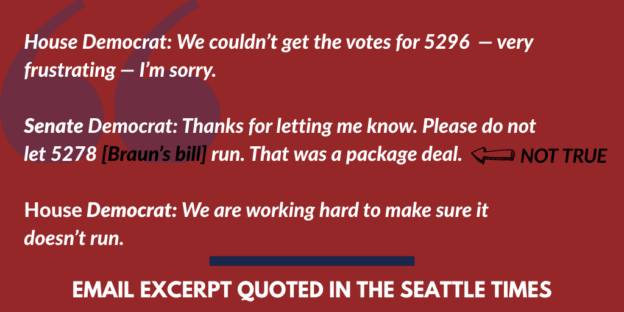
After the session, The Seattle Times submitted a public records request seeking communications between House leadership and the sponsor of a separate bill (Senate Bill 5296) that proposed sentencing reforms for juvenile offenders. While my bill aimed to solve a pressing problem by relocating violent adult inmates, the SB 5296 focused on changing how young people are sentenced in the future.

The Times reported that internal correspondence suggested the two bills were linked as a “package,” even though they addressed different issues and timelines—and were never tied together in any way. This falsehood was used to justify preventing my bill from moving forward.

This violated the public trust.

I’m disappointed by how it played out, but I’m not giving up.

I will reintroduce my bill in the upcoming session and continue working to bring meaningful reform to our juvenile justice system. Green Hill can—and must—be made safer for the youth housed there and the dedicated staff who show up every day to help them succeed.

Thank you for the opportunity to serve. I’ll keep you updated.

Sincerely,

Senator John Braun


A closer look:

Where’s all the “Climate Commitment Act” money going?

The operating budget passed by the Legislature this past session for the 2025-27 biennium spends $174 million dollars collected through the “Climate Commitment Act,” supposedly to improve Washington’s environment.

Where is that money going?

The Washington Policy Center has been tracking these expenditures and reporting them on its website. If you take a look, you’ll find:

  • Washington state has collected nearly $4 billion in C02 taxes since the “CCA” took effect in 2023.
  • More than 70% of the money goes toward increasing government bureaucracy, including hiring government employees and paying for studies.
  • Only 9% of the $174 million in the operating budget goes toward actual “environmental projects.”
  • Despite the former governor using asthmatic children as a messaging tool to promote the “CCA,” less than 0.2% of the spending goes toward reducing childhood asthma.

The following excerpt from the WPC website explains the problem further:

“Supporters of these expenditures will argue that government overhead is necessary to manage programs that help achieve Washington’s climate goals. However, that has been the approach for two decades and the state has consistently failed not only to meet its CO2 targets but even to reduce emissions. The state has spent billions of dollars on government programs and bureaucracy, always with the promise that results will follow at some point in the future.”  

The capital budget also includes money earmarked for climate projects. I encourage you to visit the website again in the future to see the WPC’s analysis of how that money is being spent as well.

You deserve to know.


Instead of failing our children, focus on making their lives better

The following is an opening excerpt from my most recent commentary in The Chronicle. Read the full commentary.


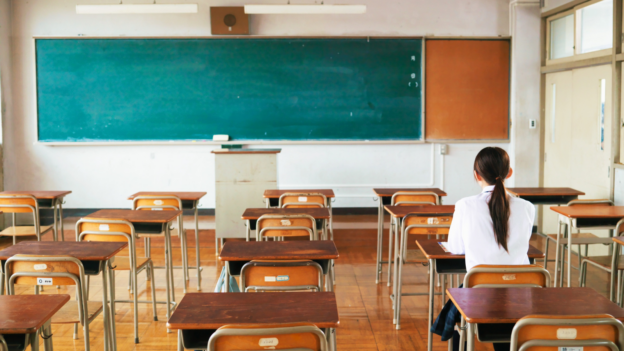
In November 2020, about eight months into the COVID-19 pandemic, I called attention to how classroom closures were causing academic, emotional and social harm to the majority of K-12 students across our state — especially those from lower-income families, and children with special educational needs.

The 2020-21 school year was only about two months along, yet there were already obvious signs that the state’s remote-learning approach was failing our children both “literally and figuratively,” as I put it in a policy paper shared with my fellow legislators and the news media at that time.

While most classrooms eventually reopened the following spring, the damage had already been done. That could and should have been the low point for our state’s children. Yet the failures have continued in the nearly five years since, and in more ways.

Read more…


LISTEN to my most recent podcast…

Budget Discipline and Legislative Accountability

Governor signs Braun bill expanding technical education to 6th graders

OLYMPIA…A bill sponsored by Sen. John Braun, R-Centralia, to expand exploratory career and technical education (CTE) to sixth-grade students was signed today by Gov. Bob Ferguson. It will become law 90 days after the Legislature adjourns.

Currently, K-12 education funding provides exploratory CTE to students beginning in seventh grade. Exploratory CTE introduces students to a variety of career paths and industry sectors, sparking their curiosity through early exposure to career options. Senate Bill 5358 expands funding to include sixth graders in the program.

“While we encourage students to attend college, we should also encourage middle school students to explore career options that don’t require a four-year degree – to see what’s out there,” Braun said. “Even if they do choose to go to college, they’ll have a greater appreciation for the trades.”

Middle-school CTE courses cover a wide range of topics, including computer applications such coding and digital design, business management and entrepreneurship, healthcare diagnostics, manufacturing, construction, automotive technology, fabrication and welding, horticulture, early education and the culinary arts. They focus on career exploration, teamwork and problem-solving and typically incorporate field trips and guest speakers to connect students with real-world opportunities.

“Right now, seventh graders can participate in CTE courses, but sixth graders in the same schools cannot,” he added. “My bill expands the funding so all middle school students can participate. At that age, CTE courses help students explore their interests. If they continue into high school, they learn more advanced skills and how to prepare for the workforce. For some students, this exposure can mean the difference between a minimum-wage job and a career that provides a living wage. The demand for workers with technical skills is growing all the time.”

High school students in Washington also have access to CTE courses, but those are considered preparatory. Those courses offer in-depth training in a specific career pathway, including technical skills, certifications and work-based learning such as internships and apprenticeships. Preparatory CTE courses for 11th and 12th graders are taught at skills centers during the regular school day.

Senate committee backs Braun bill to reduce chronic absenteeism

OLYMPIA… A bill introduced by Senate Republican Leader John Braun, R-Centralia, to help school districts address chronic absenteeism has been approved by the Senate Early Learning and K-12 Education Committee and now awaits consideration by the full Senate.

Senate Bill 5007 is aimed at supporting students at risk of falling behind academically due to excessive absences.

In September 2024, KUOW radio reported Washington remains among the worst states for chronic absenteeism, with roughly 30% of students missing more than 10% of the school year—approximately three weeks. While that figure reflects some improvement over the prior year, it remains twice the pre-pandemic level and higher than the national average of one in four students.

“This is a straightforward issue,” said Braun. “Students who don’t attend school regularly struggle to keep up, and that puts them at a disadvantage. Some families face challenges that make regular attendance difficult, and schools need more support to help address those barriers. This bill provides tools to parents and educators to help get students back in the classroom.”

Braun noted that chronic absenteeism is linked to lower graduation rates and long-term economic and health challenges.

“If we can do more to prevent those outcomes, we should,” he said. “I appreciate the committee’s support and hope the full Senate will consider the bill soon.”

Subject to available funding, SB 5007 would require each of Washington’s nine educational service districts to develop training and coaching programs for school staff focused on reducing absenteeism. It would also expand the Building Bridges Program to include chronically absent students, offering grants to community-based organizations, tribes, and community and technical colleges to support intervention efforts.

The Building Bridges Program is a local partnership of schools, families and communities that provides:

  • A means of identifying students at risk of dropping out
  • Coaches or mentors to provide support
  • Staff to coordinate the community partners so there is a continuum of academic and nonacademic resources
  • Retrieval/reentry activities
  • Alternative educational programming

NEWSLETTER: Democrats undermining your right to know

Watch my weekly legislative update:

Friends and Neighbors,

Nearly 500,000 Washington voters signed on to Initiative 2081, knowns as the Parents’ Bill of Rights. Last session, legislators on both sides of the aisle, including me, spoke in favor of the initiative and why it was a positive step. It passed with bipartisan support.

Fast forward to this session. In a move that ignores the will of the people and undermines the purpose of the law to protect parents’ “right to know,” Democrats are moving bills forward that would weaken that right.

The most concerning of these is Senate Bill 5181. This bill has many problems, such as lengthening the time the school has to notify you if your child is attacked. It also creates some exceptions to when schools even have to notify parents.

When current law limits minor access to tanning beds and tattoo parlors, why are we limiting parents’ knowledge of their children’s medical issues.

Listen to my legislative update on this issue.

All parents should worry about this effort.

My weekly column in The Chronicle elaborates on SB 5181 and what it really means for our state. Read my full column.

If you want to share your opposition to this bill, contact the following legislators who have control over what happens to this bill — and your right to know.


LISTEN: Official Podcast

Our caucus produces an official podcast that is a great way to hear about what’s happening in the Legislature. It’s called The Elephant in the Dome.

In this episode, our staff hosts and I delve into Democrat efforts to limit parental rights, and the challenges and opportunities in education founding. I also talk about my vision for a reimagining of The Evergreen State College.

Read my news release about my proposal to close Evergreen and turn it into a South Sound UW campus dedicated to training medical workers to care for the 3.2 million Washingtonians who will be part of a “Silver Tsunami” in five years that will overwhelm our health-care system.

Listen to additional episodes on our website.

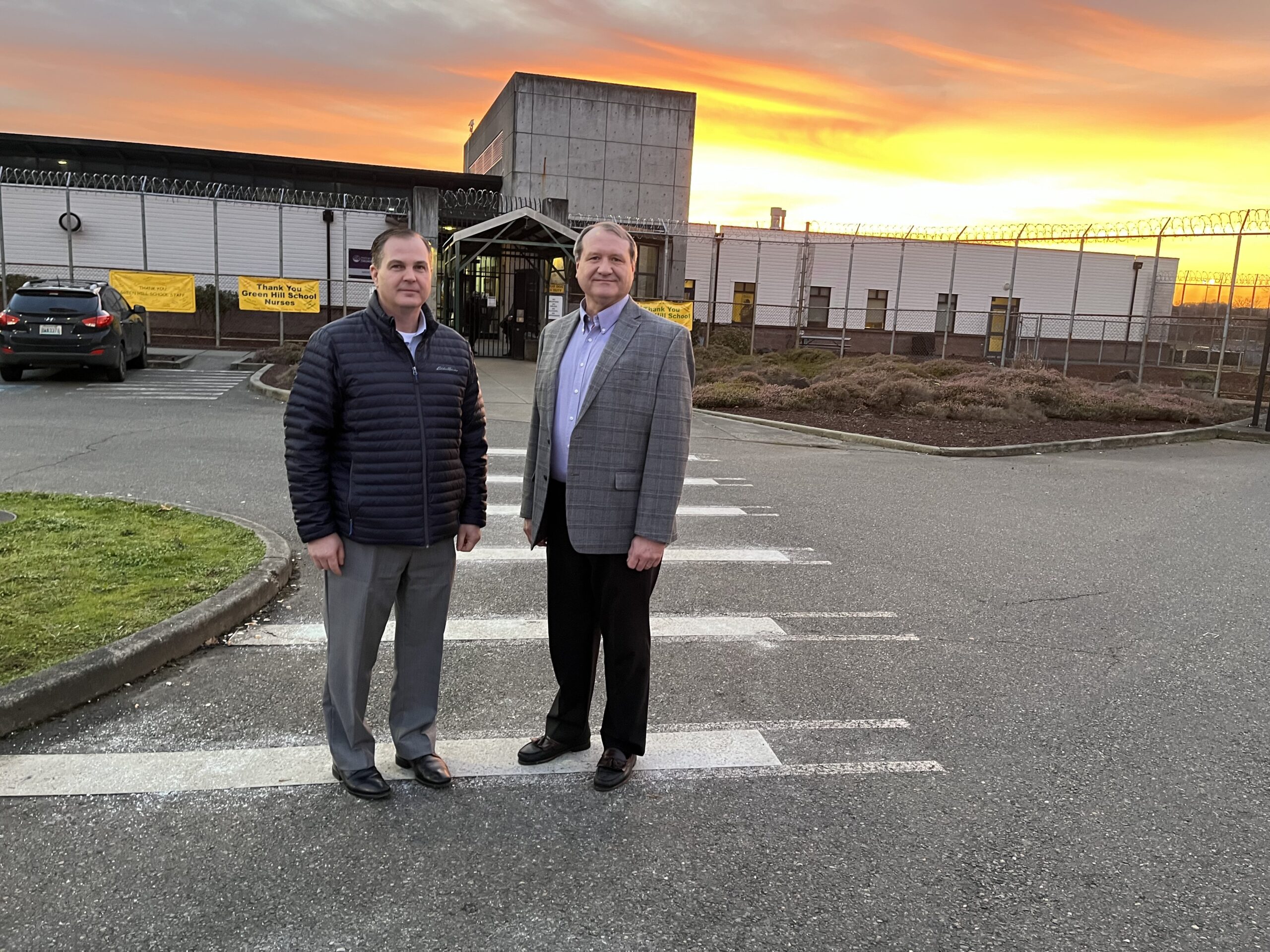
Another firsthand look at conditions at Green Hill

I talk a lot about what happens at the Green Hill School, the juvenile justice facility in Chehalis, because it has been riddled with serious overcrowding and poor management protocols — two things that have made it a dangerous and unproductive rehabilitation environment.

At the invitation of Sen. Leonard Christian, 4th Legislative District, I accompanied him on another tour of Green Hill. He is the current lead Republican on the Senate Human Services Committee, which is assigned to consider bills related to Green Hill and my bill that would repeal JR-25— the policy that allows residents convicted of a crime as a minor to remain at the facility until age 25 rather than transfer to a jail run by the Department of Corrections. Green Hill is under the jurisdiction of the Department of Children, Youth and Families.

We have a duty to the residents in the program to keep them safe and prepare them to face a brighter future when they are released. We also have a responsibility to keep staff safe in the workplace, and set them up for success with a solid policy framework. I’ll continue to update you on this as my bills progress, as well as others that seek to improve conditions.

A safer Washington: Hiring more law enforcement officers

A dubious distinction for Washington is that we remain dead last of all 50 states in the number of law-enforcement officers per capita protecting the people.

Fixing that remains a top priority for my caucus and me. My colleague, Sen. Jeff Holy, 6th Legislative District, sponsored two bills this session to provide state funding and incentivize county and local government to hire more officers.

Senate Bill 5285 incentivizes cities and counties to contribute additional funding toward hiring officers by allowing them to impose a 0.10 percent sales tax to pay for it. The bill would protect that money by mandating that the funds be spent ONLY on hiring law enforcement officers.

Senate Bill 5060 provides $100 million in grants to help fund salaries for new officers. This bill received a hearing and passed out of committee. We expect to see it come to the floor soon for a vote.

Gov. Ferguson gave Sen. Holy a shoutout during his inaugural speech during the opening week of legislative session, saying he wanted to work with him on this issue and would not sign a budget that did not contain that funding.

Both bills have bipartisan support and are working their way through the legislative process. I hope to announce that both of these bills have been signed by the governor sooner rather than later. Washington will be safer for it. Stay tuned and watch their progress.

Braun letter takes Governor’s budget proposal to task – previous budget decisions were “indefensible”

In advance of the Governor’s budget submittal due in December, Sen. John Braun, R-Centralia, sent the attached letter to the director of the Office of Financial Management. The letter seeks to ensure that recent collective bargaining agreements (CBAs),that were conducted in secret, are financially feasible as required by law.

The cost of the CBAs total over $700 million from the state’s general fund in the next two years and more than $1.7 billion over the next four.

Braun points out “indefensible” budget decisions from the previous budget cycles collective bargaining agreements that:

  • Reduced nursing home payments by over $100 million;
  • Eliminated funding for “Safe Babies, Safe Moms”;
  • Reduced breast, cervical and colon cancer screenings for low-income individuals by 15 percent;

And much more…

Read the full letter here.

Senate approves Braun bill to bring timber money back to schools

The state Senate today approved Sen. John Braun’s legislation that would make permanent a state policy that returns money from federal timber sales to local schools. Senate Bill 6292 would eliminate the reduction of state school funding to districts based on what they receive in federal forest revenues. The measure cleared the Senate by a vote of 35-14 and moves to the House of Representatives for consideration.

“This bill makes a small but needed change to restore resources for many of our school districts, especially in rural areas,” said Braun. “The state has been reducing its basic education funding to districts that received federal timber revenues, and that places extra burdens on the districts that are least able to handle them.”

Currently, 21 percent of property in Washington is designated as national forest, which is exempt from property tax. These federal funds are designated to go to the school districts in those areas to make up for lost property tax revenue. However, the state has been deducting that same amount from their basic education funding, effectively negating the goal of the program. Braun’s bill would eliminate the reduction in state basic-education funding to school districts that receive federal forest revenue, restoring the original intent of Congress.

“I’ve worked over the past several years to keep these funds available through the budget to the 215 school districts that receive federal forest revenues and this legislation provides a permanent solution,” Braun said.

Day 94: Budget countdown continues

Web Banner

April 15, 2015


Day 94: Budget countdown continues

I am beginning the countdown to the end of the 2015 legislative session, highlighting the need to complete budget negotiations by April 26.

Today is the 94th day of the 105-day legislative session, the 19th day since House Democrats rolled out a budget proposal that won’t balance without $1.5 billion in new taxes, and the 13th day that House leaders have failed to bring their proposed tax increases to a vote. Successful leaders do not write checks that they are not prepared to cover.

The Senate passed a complete, no-new taxes budget, but it appears House Democrats don’t have the votes to pass their own tax proposals. We welcome them to drop their needless push for more revenue and support a sustainable budget which meets the needs of our state without new taxes. That’s how we can finish the people’s business on time and on budget.

Thank you for allowing me to serve as your state senator.

John Braun,

20th District Senator


Committee Assignments

This year, in addition to serving on the Environment, Energy and Telecommunications committee, I am serving as vice-chair of three committees: Trade and Economic Development, Commerce and Labor and Ways and Means. I also have the honor of serving as the Senate Deputy Majority Leader.

Contact Me

Email:

John.Braun@leg.wa.gov

Olympia Office:

407 Legislative Building

PO Box 40420

Olympia, WA 98504-0420

Phone:

(360) 786-7638

Website:

www.SenatorJohnBraun.com


Click Here to Sign up for my E-Newsletter

[[SHARE]]